Have you heard the news! We have been crowned the Most Innovative Company of the Year 2012 by Best in Biz awards EMEA.
We are delighted to have won this award which was judged by distinguished business journalists and industry analysts from around the world.
What made P2i stand out?
Good question. We were awarded 'Gold' by Best of Biz for the developments we have made from low volume processing into a high volume solution that now sees our nano-coating technology applied to millions of smartphones, tablets and hearing aids across the globe.
It was made even more special to win this award as it echoes our achievements of 2011 where we were named Most Innovative Company in Europe by the International Business Awards, received the Fast Growth Business award for Best Use of Technology and were awarded the Borderless Business (Business Hero) award by Management Today. You can read more about these awards from the links below:
You can find out more about our nano-coating technology for electronics, Aridion, here.
Showing posts with label aridion. Show all posts
A Brief History of Nanotechnology: Part 5 - A Glimpse at the Future
Over the last few weeks, we've touched on the history of nanotechnology, tracing its roots as far back as the ancient world, examining its emergence as a field of study in the second half of the 20th century and outlining a number of more recent advances. In this, the final instalment of the series, we look at how nanotechnology might develop even further in the not too distant future.
In 2006 a Scientific American article estimated that between 1997 and 2005, "investment in nanotech research and development by governments around the world soared from $432 million to about $4.1 billion and that by 2015, products incorporating nanotech will contribute approximately $1 trillion to the global economy". This increase of investment in and around nanotechnology could have far-reaching effects, impacting everything from how we manufacture products to how we fight diseases, such as cancer.
One speculative area of nanotechnology that could be very exciting for instance, is molecular manufacturing, which when put simplistically is "the ability to bring materials to life from the simple molecular reconstruction of everyday beings" an idea that Richard Feynman first described in 1959. And in 1999, claims went even further, stating that molecular nanotechnology "will let us make remarkably powerful molecular computers. It will let us make materials over fifty times lighter than steel or aluminium alloy but with the same strength. We'll be able to make jets, rockets, cars or even chairs that, by today's standards, would be remarkably light, strong, and inexpensive. Nanotechnology will replace our entire manufacturing base with a new, radically more precise, less expensive and more flexible way of making products."
There are also many potential uses for nanotechnology in medicine as well. A preliminary study has indicated that nanoparticles could be used to target and treat cancer in the future by homing in on certain proteins and delivering medication. Meanwhile, researchers have developed artificial muscles that could help propel nanobots through a person's body in order to diagnose and treat medical conditions. These "doctor bots" as they have been dubbed might sound like the stuff of a mad scientist's dreams, but they're a real possibility.
Of course, these statements about the future of nanotechnology as a field are just speculative at the moment and difficult to predict, as are the scientific and societal implications of such developments. But one thing is clear, at least: nanotechnology is a very powerful science, with huge capacity to influence or change many different aspects of our lives.
And with that, our brief look at the history and developments of nanotechnology has come to an end. If you have any questions regarding nanotechnology and nano-coatings in general or are interested to know more about our own technology, just ask. You can find out more about how our nanotechnology is applied to different markets here: http://www.p2i.com/applications
In 2006 a Scientific American article estimated that between 1997 and 2005, "investment in nanotech research and development by governments around the world soared from $432 million to about $4.1 billion and that by 2015, products incorporating nanotech will contribute approximately $1 trillion to the global economy". This increase of investment in and around nanotechnology could have far-reaching effects, impacting everything from how we manufacture products to how we fight diseases, such as cancer.
One speculative area of nanotechnology that could be very exciting for instance, is molecular manufacturing, which when put simplistically is "the ability to bring materials to life from the simple molecular reconstruction of everyday beings" an idea that Richard Feynman first described in 1959. And in 1999, claims went even further, stating that molecular nanotechnology "will let us make remarkably powerful molecular computers. It will let us make materials over fifty times lighter than steel or aluminium alloy but with the same strength. We'll be able to make jets, rockets, cars or even chairs that, by today's standards, would be remarkably light, strong, and inexpensive. Nanotechnology will replace our entire manufacturing base with a new, radically more precise, less expensive and more flexible way of making products."
There are also many potential uses for nanotechnology in medicine as well. A preliminary study has indicated that nanoparticles could be used to target and treat cancer in the future by homing in on certain proteins and delivering medication. Meanwhile, researchers have developed artificial muscles that could help propel nanobots through a person's body in order to diagnose and treat medical conditions. These "doctor bots" as they have been dubbed might sound like the stuff of a mad scientist's dreams, but they're a real possibility.
Of course, these statements about the future of nanotechnology as a field are just speculative at the moment and difficult to predict, as are the scientific and societal implications of such developments. But one thing is clear, at least: nanotechnology is a very powerful science, with huge capacity to influence or change many different aspects of our lives.
And with that, our brief look at the history and developments of nanotechnology has come to an end. If you have any questions regarding nanotechnology and nano-coatings in general or are interested to know more about our own technology, just ask. You can find out more about how our nanotechnology is applied to different markets here: http://www.p2i.com/applications
Exhibiting at CTIA Wireless 2012
This week we have been exhibiting for the first time at CTIA Wireless in New Orleans. The show is a leading electronics event and we were there showcasing our Aridion technology to a host of brands, businesses and media.
You can see some images of our booth further below but one of the highlights from the event was the video that Phone Arena took of our demonstration which you can watch by clicking the below screen:
You can read the article in full here. If you would like to know more about Aridion and how it works do ask in the comments below otherwise you can visit www.aridion.com
You can see some images of our booth further below but one of the highlights from the event was the video that Phone Arena took of our demonstration which you can watch by clicking the below screen:
You can read the article in full here. If you would like to know more about Aridion and how it works do ask in the comments below otherwise you can visit www.aridion.com
Update from NEPCON 2012
We are currently exhibiting at the 2012 NEPCON Expo in Shanghai where the electronics world gathers for 3 days to see new product launches and learn about industry developments and trends.
This is our first time at the Expo where we are showcasing and demostrating our Aridion technology. Here are collection of images from Shanghai:
NECPON finishes tomorrow (Friday 27th) so if you are at the show come and visit us in booth 1H57. You can also find out more about how Aridion works here: https://www.youtube.com/watch?v=c83n-vkno8U
This is our first time at the Expo where we are showcasing and demostrating our Aridion technology. Here are collection of images from Shanghai:
| The Shanghai skyline |
![]() |
| Entrance to NEPCON 2012 |
![]() |
| Our booth gathers a crowd |
![]() |
| Our booth before the expo opened |
Scott Steinberg highlights Aridion as technology to look out for in 2012
Scott Steinberg, technology analyst for broadcast networks including CNN, FOX, NBC and publications such as The New York Times and Wired has spoken with NewsWatch TV about some of the top technology products to look out for in 2012. And Aridion technology is one of them!
The show which was hosted by Scott, was broadcast across America on the 5th April and highlighted what technology products are worth keeping your eye out for this year. The show which is 30 minutes in length showcased our Aridion technology towards the end of the episode and you can watch our segment below:
If you would like to know more about Aridion and how it protects electronics from water and corrosion damage you can here.
The show which was hosted by Scott, was broadcast across America on the 5th April and highlighted what technology products are worth keeping your eye out for this year. The show which is 30 minutes in length showcased our Aridion technology towards the end of the episode and you can watch our segment below:
If you would like to know more about Aridion and how it protects electronics from water and corrosion damage you can here.
We did it again!
So we have returned from AudiologyNOW! 2012 and not only was it a great show but we are delighted to have won the Best of Show award for the second year running! What makes it even more exciting is that this is the first times in AudiologyNOW's history that a company has won the award twice.
Winning the award topped off what was another great show for us, where we increased awareness of Aridion™ as well as introducing the technology to new businesses and people.
We have put up a collection of images from the show which you can see on our Flickr site as well as watching a montage of what we got up to below:
| P2i's CEO, Carl Francis and Natalia Delclaux accepting the award from AudiologyNOW! |
| The 2012 Best of Show award |
We have put up a collection of images from the show which you can see on our Flickr site as well as watching a montage of what we got up to below:
Returning to AudiologyNOW!
About this time last year our booth was crowned the Best of Show at AudiologyNOW! 2011 and we are back exhibiting at this year's show which takes place in Boston from the 29th-31st March 2012.
Our fingers are crossed, hoping to win the Best of Show award again but our real aim at AudiologyNOW! 2012 is to promote and demonstrate our Aridion™ technology. Since the 2011 show, Aridion™ is now applied to approximately 60% of hearing aids worldwide, protecting them against water and corrosion damage which can occur where moisture, sweat and cerumen builds up.
These types of environments can all be found within and around the ear and are a significant factor in causing hearing aids to malfuction. Aridion™ signfincantly reduces the damage caused by liquid and moisture resulting in longer lasting devices and reduced return rates.
AudiologyNOW! is the world's largest gathering of audiologists and we are looking forward to once again showcasing how Aridion™ can revolutionize the performance of hearing aids for manufacturers and consumers.
Below are some images from last years show:
We will be tweeting from the show and you can follow us on Twitter here.
Our fingers are crossed, hoping to win the Best of Show award again but our real aim at AudiologyNOW! 2012 is to promote and demonstrate our Aridion™ technology. Since the 2011 show, Aridion™ is now applied to approximately 60% of hearing aids worldwide, protecting them against water and corrosion damage which can occur where moisture, sweat and cerumen builds up.
These types of environments can all be found within and around the ear and are a significant factor in causing hearing aids to malfuction. Aridion™ signfincantly reduces the damage caused by liquid and moisture resulting in longer lasting devices and reduced return rates.
AudiologyNOW! is the world's largest gathering of audiologists and we are looking forward to once again showcasing how Aridion™ can revolutionize the performance of hearing aids for manufacturers and consumers.
Below are some images from last years show:
![]() |
| CEO, Carl Francis and Natasha Verniquet with the Best of Show Award |
![]() |
| Capture of the P2i booth from the foyer |
Waterproof and water repellent electronics...
On the back of the International CES and Mobile World Congress (MWC) tradeshows there has been an increased amount of discussion, and at times confusion on the difference between waterproof and water repellent electronics. In this post, we will shed more light and understanding on the subject, but before we begin, here is how each is defined:
How do electronics become waterproof?
The term waterproof is itself confusing as there are varying scales of 'waterproofness' that can be measured to determine how well electronics perform in and around water. This scale is known as the Ingress Protection Rating (IPX) and is based on a scale of 0-8 where 0 means it has no protection and 8 means it can handle continuous immersion in water. For example, an electronic device that has an IPX7 rating is protected against water submersion to a depth of 1m for no longer than 30mins. The level of water protection a device is capable of is usually highlighted by the manufacturer either on the device or in the manual.
For a smartphone to pass IPX6 and above, the devices physical appearance is normally compromized and this can be seen through the development of ruggedized handsets that feature protective rubber and plastic casings, as below:
Fast forward to today and what was clear from the coverage at CES and MWC is that there is a strong desire for devices to be able to withstand water or other liquids. But unlike the above, the devices that are now appearing and claiming to be waterproof are not basic phones but instead are the latest smartphones on the market. What's more, these devices do not appear to have a protective case at all.
How are these new devices waterproof?
Well the answer is quite simple, gaskets and O-rings. Before water can reach the valuable internal components where all our data is stored there are barriers in place in the forms of gaskets and O-rings. For quick reference a gasket is a mechanical seal which fills the space between two or more surfaces to prevent leaking while an O-ring is designed to be compressed between two parts creating a seal. While both these barriers stop water from penetrating inside the device they can still alter physical aspects of the device making them bulky as well as expensive to produce and purchase.
There is also another problem, these seals can be comprised by general use and over time the parts can move or be damaged should the device be dropped. If just one of these barriers were to break, water would then be able seep inside towards the circuit board and internal components, resulting in device failure and loss of data as the inside becomes exposed to water.
Why repellency over waterproof?
Firstly, we need to be clear what repellent means when talking about electronics and how it differs from waterproof. That is where Aridion™ comes in.
The key difference is that electronics treated with Aridion™ will still allow water to get inside. Does that mean the end of the devices life? Not necessarily, as Aridion™ molecularly bonds to both the inside and outside of the entire device ensuring that each and every exposed surface is coated. This means that any water that does come into contact will move away from the surface rather than sticking to the device and if water does get inside, the internal components are also treated, producing the same effect.
This type of protection allows the device to be created without having to compensate for a protective casing, gaskets or O-rings. What is important to remember however is that even though the water is repelled, the coating does not make the device waterproof as it is not designed to withstand submersion.
You can get a better idea of how the coating is applied and works in this video:
Aridion™ provides water protection by removing the buildup of corrosion. Corrosion occurs not just when a phone is submerged but in high humidity and moisture environments such as saunas, in the bathroom when having a shower or traveling through different temperatures. All these factors can lead to internal moisture buildup which over time can corrode the circuits. Aridion™ protects against this as it stops the water/moisture from sticking to and in between the components which would result in electrochemical migration. Electrochemical migration is the movement of metal ions between conductors and if this happens the device short circuits.
So what is the difference?
In the simplest terms, for a device to be waterproof it has to either be completely sealed and ruggedized (making them bulky) or alternatively it must have barriers in place which stops water from penetrating through. The disadvantage with that being these seals can break resulting in the device becoming susceptible to water and corrosion damage.
Water repellent does not mean waterproof but it does mean protection from splashes, spills, corrosion and water damage brought on by the scenarios mentioned earlier (humidty and moisture) as well as those 'caught out in the rain' moments we have all experianced.
If you would like to know more about Aridion™ technology and the benefits it offers you can here.
The following video which was filmed at MWC with our CTO Dr. Stephen Coulson visibly demonstrates the benefits that Aridion™ offers to electronics devices:
Aridion™ is applied during the manufacturing process and is already applied to over 9 million devices including the Motorola RAZR and XOOM 2.
- Waterproof: Impervious to water
- Water Repellent: Treated with a finish that is resistant but not impervious to penetration by water
How do electronics become waterproof?
The term waterproof is itself confusing as there are varying scales of 'waterproofness' that can be measured to determine how well electronics perform in and around water. This scale is known as the Ingress Protection Rating (IPX) and is based on a scale of 0-8 where 0 means it has no protection and 8 means it can handle continuous immersion in water. For example, an electronic device that has an IPX7 rating is protected against water submersion to a depth of 1m for no longer than 30mins. The level of water protection a device is capable of is usually highlighted by the manufacturer either on the device or in the manual.
For a smartphone to pass IPX6 and above, the devices physical appearance is normally compromized and this can be seen through the development of ruggedized handsets that feature protective rubber and plastic casings, as below:
![]() |
| Sonim XP3 waterproof phone |
How are these new devices waterproof?
Well the answer is quite simple, gaskets and O-rings. Before water can reach the valuable internal components where all our data is stored there are barriers in place in the forms of gaskets and O-rings. For quick reference a gasket is a mechanical seal which fills the space between two or more surfaces to prevent leaking while an O-ring is designed to be compressed between two parts creating a seal. While both these barriers stop water from penetrating inside the device they can still alter physical aspects of the device making them bulky as well as expensive to produce and purchase.
There is also another problem, these seals can be comprised by general use and over time the parts can move or be damaged should the device be dropped. If just one of these barriers were to break, water would then be able seep inside towards the circuit board and internal components, resulting in device failure and loss of data as the inside becomes exposed to water.
Why repellency over waterproof?
Firstly, we need to be clear what repellent means when talking about electronics and how it differs from waterproof. That is where Aridion™ comes in.
The key difference is that electronics treated with Aridion™ will still allow water to get inside. Does that mean the end of the devices life? Not necessarily, as Aridion™ molecularly bonds to both the inside and outside of the entire device ensuring that each and every exposed surface is coated. This means that any water that does come into contact will move away from the surface rather than sticking to the device and if water does get inside, the internal components are also treated, producing the same effect.
This type of protection allows the device to be created without having to compensate for a protective casing, gaskets or O-rings. What is important to remember however is that even though the water is repelled, the coating does not make the device waterproof as it is not designed to withstand submersion.
You can get a better idea of how the coating is applied and works in this video:
Aridion™ provides water protection by removing the buildup of corrosion. Corrosion occurs not just when a phone is submerged but in high humidity and moisture environments such as saunas, in the bathroom when having a shower or traveling through different temperatures. All these factors can lead to internal moisture buildup which over time can corrode the circuits. Aridion™ protects against this as it stops the water/moisture from sticking to and in between the components which would result in electrochemical migration. Electrochemical migration is the movement of metal ions between conductors and if this happens the device short circuits.
So what is the difference?
In the simplest terms, for a device to be waterproof it has to either be completely sealed and ruggedized (making them bulky) or alternatively it must have barriers in place which stops water from penetrating through. The disadvantage with that being these seals can break resulting in the device becoming susceptible to water and corrosion damage.
Water repellent does not mean waterproof but it does mean protection from splashes, spills, corrosion and water damage brought on by the scenarios mentioned earlier (humidty and moisture) as well as those 'caught out in the rain' moments we have all experianced.
If you would like to know more about Aridion™ technology and the benefits it offers you can here.
The following video which was filmed at MWC with our CTO Dr. Stephen Coulson visibly demonstrates the benefits that Aridion™ offers to electronics devices:
Aridion™ is applied during the manufacturing process and is already applied to over 9 million devices including the Motorola RAZR and XOOM 2.
Returning from Mobile World Congress 2012
Having attended Mobile World Congress (MWC) for the first time last year we returned to Barcelona bigger and better.
With such a great show in 2011 we hoped that this year would bring similar results and we were not wrong, in fact the the buzz and coverage we recieved surpassed all our expectations.
Before MWC officially kicked off we attended ShowStoppers, a media only event that allowed us to demonstrate our Aridion™ technology to media and journalists from around the world as well as answering any questions they had. Over the course of the day we were interviewed by leading technology sites including Mashable and BBC Technology.
MWC which ran from the 27th February to the 1st March, the pattern continued as we carried out almost hourly interviews and demonstrations and you can see a collection of these interviews and videos by liking our Facebook page and clicking the links. We were also the topic of conversation for many podcast sites and you can listen to The Fonecast interview with our CTO, Dr. Stephen Coulson here and clicking on the Electronics tab.
In addition to this, MWC was also the venue to announce the winner of the Smart UK Project award. The Project was set up to find Britain's most innovative mobile company and despite not winning the award we were delighted to be a finalist from 79 initial company entries. You can watch the summary of the Smart UK Project awards here.
The show was a great success and you can see some of the images from our booth below:
If you have any questions about our Aridion technology and how it protects your electronics from water damage, you can email us at info@p2i.com.
Next up for us is AudiologyNOW! in Boston.
![]() |
| Our booth at MWC 2012 |
Before MWC officially kicked off we attended ShowStoppers, a media only event that allowed us to demonstrate our Aridion™ technology to media and journalists from around the world as well as answering any questions they had. Over the course of the day we were interviewed by leading technology sites including Mashable and BBC Technology.
MWC which ran from the 27th February to the 1st March, the pattern continued as we carried out almost hourly interviews and demonstrations and you can see a collection of these interviews and videos by liking our Facebook page and clicking the links. We were also the topic of conversation for many podcast sites and you can listen to The Fonecast interview with our CTO, Dr. Stephen Coulson here and clicking on the Electronics tab.
In addition to this, MWC was also the venue to announce the winner of the Smart UK Project award. The Project was set up to find Britain's most innovative mobile company and despite not winning the award we were delighted to be a finalist from 79 initial company entries. You can watch the summary of the Smart UK Project awards here.
The show was a great success and you can see some of the images from our booth below:
| Hannibal our magician performs to the crowd |
| The team |
Next up for us is AudiologyNOW! in Boston.
CES validates P2i as liquid repellent world leader
In January last year we attended International CES in Las Vegas where we showcased Aridion™, our liquid repellent technology for consumer electronic devices and you can read how we got on here.
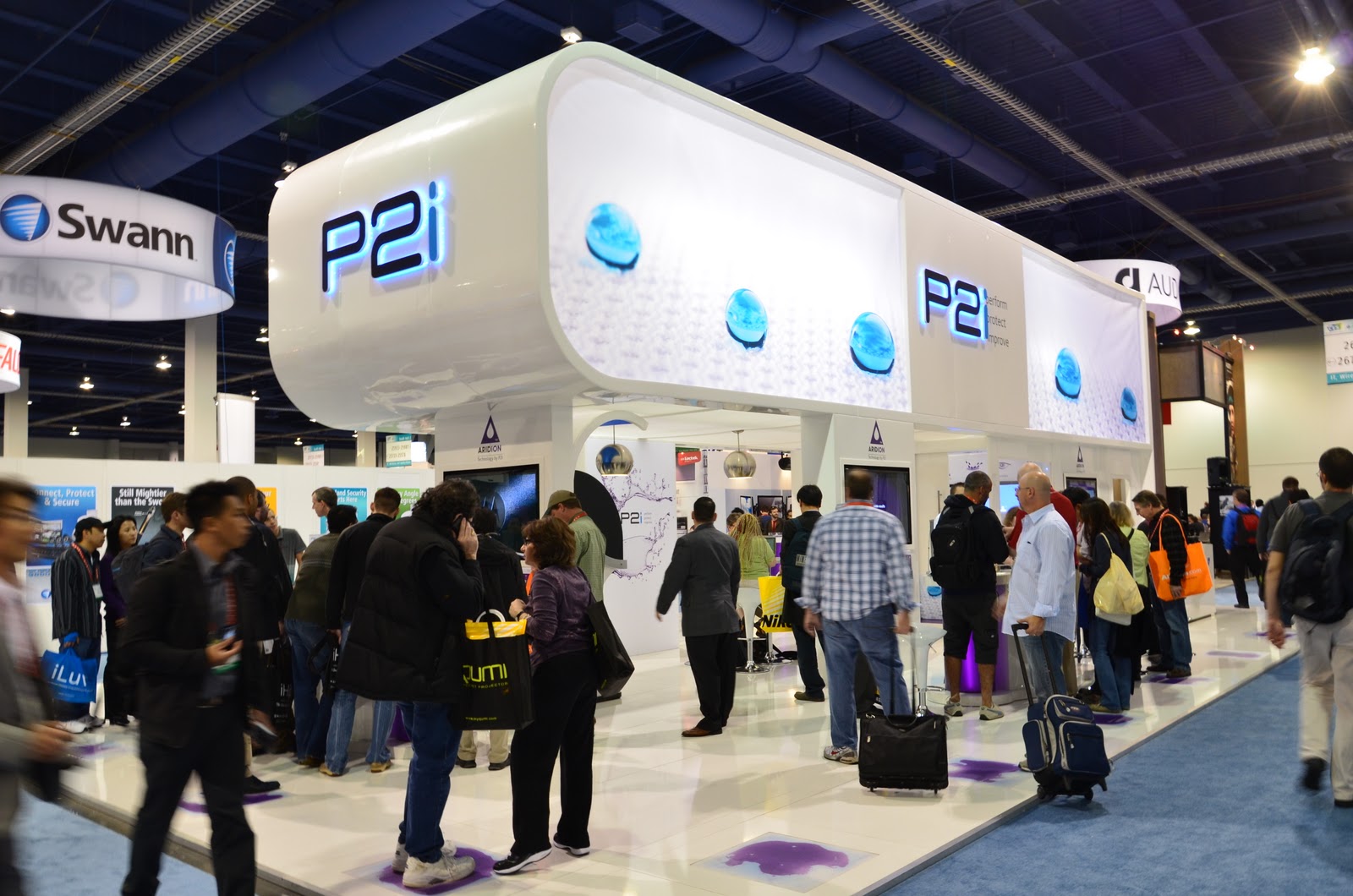
For 2012 we went back to CES with an even bigger booth and a major electronic manufacturer incorporating Aridion™ into their production process.
International CES, which took place from the 10th-13th January is the world's largest tradeshow for consumer electronics as well as a showcase for the latest technologies. The 2012 event was the largest in it's 44 year history with over 153,000 attendees and more than 3,100 exhibitors gathering to see the latest technological developments.
Throughout the four days our booth maintained a continous flow of delegates keen to see a demonstration of Aridion™ technology as well as discovering how it can protect electronic devices from liquid damage and corrosion. What was also great is that many delegates who visited us last year came back to our booth, this time bringing a crowd with them interested to see the technology first hand.
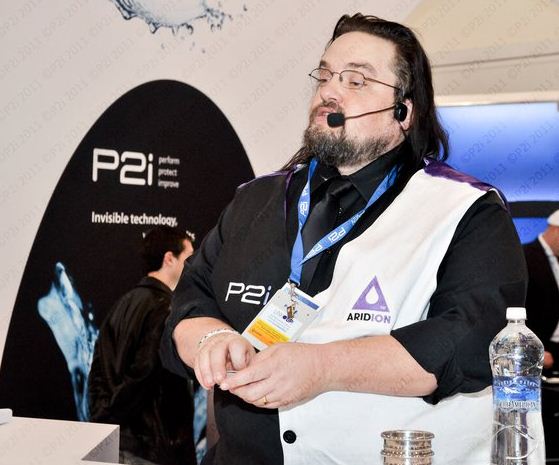
The combination of media coverage, a consistantly busy booth and Hannibal, our corporate magician entertaining the crowds, once again made CES a great success for us and validated our position as the world leaders in liquid repellent nano-coating technology for consumer electronics. We are now in further discussions with leading electronic brands about applying Aridion™ to a new range of consumer devices so watch this space.
You can see a collection of our images here as well as watching a short video we have put together showing some of the highlights from our booth:
P2i
For 2012 we went back to CES with an even bigger booth and a major electronic manufacturer incorporating Aridion™ into their production process.
International CES, which took place from the 10th-13th January is the world's largest tradeshow for consumer electronics as well as a showcase for the latest technologies. The 2012 event was the largest in it's 44 year history with over 153,000 attendees and more than 3,100 exhibitors gathering to see the latest technological developments.
Throughout the four days our booth maintained a continous flow of delegates keen to see a demonstration of Aridion™ technology as well as discovering how it can protect electronic devices from liquid damage and corrosion. What was also great is that many delegates who visited us last year came back to our booth, this time bringing a crowd with them interested to see the technology first hand.
| Images from our booth over the four days |
While the booth was busy with delegates, our technology was also picked up by a host of media and like last year, we receieved a great deal of press coverage from all kinds of sources including; PC World, Gadgetsteria, PC Advisor, Gagagadget, Nerd Reactor, Mobile Magazine, EBN News and Fox News to name but a few! There are also video features still to be posted from popular technology sites including Tech Bargins. These will be promoted on our Facebook, Twitter and YouTube accounts once live.
The combination of media coverage, a consistantly busy booth and Hannibal, our corporate magician entertaining the crowds, once again made CES a great success for us and validated our position as the world leaders in liquid repellent nano-coating technology for consumer electronics. We are now in further discussions with leading electronic brands about applying Aridion™ to a new range of consumer devices so watch this space.
You can see a collection of our images here as well as watching a short video we have put together showing some of the highlights from our booth:
You can find out more about Aridion™ by visiting: www.p2i.com/electronics and if you have any questions about how Aridion™ works do get in contact by commenting below.
P2i
P2i at CES 2012: Day two
Day two at CES is almost over and it has been great with many delegates amazed by our technology and by our tissue demonstrations. Over the two days we have also received a lot of media coverage as well as interviews and below is a list of just some of the articles that have been posted:
Nerd Reactor: CES 2012 - Dropped your phone? P2i could have saved you
PC Adivsor: P2i's Aridion safeguards smartphones against water
Gagagadget: Toilet-proof your gadgets with P2i
As you can see the coverage we are receiving is superb with many individuals and businesses interested in the opportunities that our technology presents. Throughout the day delegates have also been filming the demonstrations so we expect to see them up on YouTube very soon. We will post another update tomorrow but here are some more images from our booth:
www.p2i.com/aridion
Nerd Reactor: CES 2012 - Dropped your phone? P2i could have saved you
PC Adivsor: P2i's Aridion safeguards smartphones against water
Gagagadget: Toilet-proof your gadgets with P2i
As you can see the coverage we are receiving is superb with many individuals and businesses interested in the opportunities that our technology presents. Throughout the day delegates have also been filming the demonstrations so we expect to see them up on YouTube very soon. We will post another update tomorrow but here are some more images from our booth:
www.p2i.com/aridion
P2i at CES 2012: First day highlights
It is over a year now since we first attended International CES in Las Vegas and we are now back to showcase our technology at the 2012 event. The show in 2011 was a great experiance for us and we gained a lot of coverage including Microsoft and Cool Tools, which you can read in post from last year.
This year our booth is even bigger and we have a host of meetings with leading electronic brands and manufacturers. Dr. Stephen Couslon CTO, demonstrates our liquid repellent technology from our booth:
CES 2012 runs from the 10th-13th of January and each day we will be uploading images and videos to our Twitter, Facebook and YouTube accounts as well as posting a daily blog live from our booth.
Here are some images from our booth on the first day of CES:
All our images will be uploaded to our Facebook and Flickr accounts next week but we will add more images in tomorrow's post.
Find out more about Aridion technology at: www.p2i.com/aridion
This year our booth is even bigger and we have a host of meetings with leading electronic brands and manufacturers. Dr. Stephen Couslon CTO, demonstrates our liquid repellent technology from our booth:
CES 2012 runs from the 10th-13th of January and each day we will be uploading images and videos to our Twitter, Facebook and YouTube accounts as well as posting a daily blog live from our booth.
Here are some images from our booth on the first day of CES:
| Booth starts to gather a crowd |
| Demonstrations |
| Hannibal performs his magic |
Find out more about Aridion technology at: www.p2i.com/aridion
Aridion™ received loud and clear at EUHA 2011
Just a short post this week as we have just returned from a very successful EUHA congress in Nuremberg, Germany where we showcased our Aridion™ technology for hearing aids to an audience of audiologists, manufacturers, journalists and bloggers.
Over the three days our booth received a lot of interest and we are very excited by the potential new business prospects that emerged. Visitors to our booth were able to see the technology first hand with live demonstrations as well as an interactive hologram and of course Hannibal our corporate magician.
We also had our Aridion™ 8 machine on the booth, specifically designed to treat hearing aid devices which you can see below:
You can see a collection of images from the show on our Flickr and Facebook pages.
Next up for us is INDA 2011, a filtration tradeshow taking place in Chicago from the 15th-17th November.
Over the three days our booth received a lot of interest and we are very excited by the potential new business prospects that emerged. Visitors to our booth were able to see the technology first hand with live demonstrations as well as an interactive hologram and of course Hannibal our corporate magician.
We also had our Aridion™ 8 machine on the booth, specifically designed to treat hearing aid devices which you can see below:
| Aridion™ 8 Machine |
Next up for us is INDA 2011, a filtration tradeshow taking place in Chicago from the 15th-17th November.
Aridion™ to take centre stage at EUHA 2011
It is conference time again and today we are in Nuremberg, Germany where the 56th International Congress of Hearing Aid Acousticians (EUHA) is taking place from the 19th-21st October.
EUHA is Europe's largest hearing aid tradeshow and this will be the first time that we have had a significant presence here.
Over the coming days, from our booth (G-14) we will be showcasing our Aridion™ technology to specialists in the hearing aid and acoustic industries.
With Aridion™ now serving three of the world's largest hearing aid manufacturers and over 5.5 million devices treated we are hoping for a very successful show and will be tweeting live which you can following via our Twitter account.
If you would like to know more about Aridion™ you can here as well as watching the video below:
We will post an update next week following up on how the show went.
EUHA is Europe's largest hearing aid tradeshow and this will be the first time that we have had a significant presence here.
Over the coming days, from our booth (G-14) we will be showcasing our Aridion™ technology to specialists in the hearing aid and acoustic industries.
With Aridion™ now serving three of the world's largest hearing aid manufacturers and over 5.5 million devices treated we are hoping for a very successful show and will be tweeting live which you can following via our Twitter account.
If you would like to know more about Aridion™ you can here as well as watching the video below:
We will post an update next week following up on how the show went.
Best Use of Technology Award
What a year we are having! Back in August we won the 'Most Innovative Company in Europe' award from the International Business Awards (Stevies) and we are delighted to announce that we have won another prestigious award.
On Tuesday the 4th October at the Fast Growth Business Awards (FGBA) in London, UK, we were delighted to win the 'Best Use of Technology' award.
In what was a competitive category we won the judging panel over with our 'huge scope and potential, turnover growth and strong profit margin' which you can read in more detail via the Winner's Archive.
What do the awards represent?
The awards are organized by Growing Business magazine which is the UK's leading magazine for entrepreneurs and cutting edge businesses. The event was attended by over 300 entrepreneurs, business journalists and industry leaders.
What won us the award?
To be in contention for the 'Best Use of Technology' award, we had to demonstrate growth and success, customer satisfaction as well as showcasing a link between the use of technology and growth, something we have achieved successfully with our Aridion™ and ion-mask™ technologies.
Peter Rankin, P2i's Operations Director who accepted the award on our behalf, reflects on what this recognition means to P2i and how our technology enables continued growth for the future:
This award now sits alongside our other achievements, which include:
- International Business of the Year 2011
- Business Hero Award for 'Borderless Business'
- ISPO BrandNew Sportwear Award
CEO, Carl Francis also reflected on how our growth has established a world leading company "This award recognizes the expertise and diversity of our liquid repellent nano-coating technology across a range of market sectors, from consumer electronics to footwear and accessories. The possibilities for nano-coating are endless as P2i continues to build on our cutting edge technology by moving into other functional nano-coatings."
You can see images from the event on our Flickr page as well as keeping up to date with everything P2i through our newsletter.
On the way to IFA 2011, Berlin
We are in full tradeshow mode here. Having not long returned from EU OutDoor in Friedrichshafen where we promoted ion-mask™ we are now heading to Berlin from the 2nd-7th September for IFA 2011, to showcase Aridion™ technology.
IFA (Consumer Electronics Unlimited) is Europe's largest consumer electronics event, presenting the latest products and innovations from all the leading brands. This will be our first time exhibiting and we can't wait.
Like previous shows, visitors to our booth (Hall 9 Booth 304) will be able to see first-hand what our Aridion™ technology can do for electronics. Delegates can also take part in live demonstrations, interact with an Aridion™ specific holographic display as well as engage with Hannibal, our corporate magician.
It promises to be a very exciting show. You can find out more about IFA here as well as learning more about Aridion™ in our Electronics video below:
We look forward to seeing you there! Be sure to follow us on Twitter to see how we are getting on.
IFA (Consumer Electronics Unlimited) is Europe's largest consumer electronics event, presenting the latest products and innovations from all the leading brands. This will be our first time exhibiting and we can't wait.
Like previous shows, visitors to our booth (Hall 9 Booth 304) will be able to see first-hand what our Aridion™ technology can do for electronics. Delegates can also take part in live demonstrations, interact with an Aridion™ specific holographic display as well as engage with Hannibal, our corporate magician.
| Hannibal |
We look forward to seeing you there! Be sure to follow us on Twitter to see how we are getting on.
Faces of Nano: P2i interviewed by TechSplurge
Earlier this week our Principal Scientist, Delwyn Evans was interviewed by Julian Taub for this TechSplurge Blog as part of the Faces of Nano series. You can read the full interview below:
FACES OF NANO: Dr. Delwyn Evans
Companies are an important part of the nanotech initiative. They take lab discoveries and apply them to consumers’ daily lives. One of the most successful nanotech companies, P2i, just won the title of Most Innovative Company in Europe. P2i manufactures technology that adds liquid repellent protection for both electronics and apparel (footwear). I interview Dr. Delwyn Evans, a chemist at P2i.
JT: Tell me about yourself, your background, and your position at P2i.
DE: I’m the Principal Chemist at P2i, and my responsibilities include the development and optimization of our nano-coating technology, representing the company at conferences and training our technical staff in the chemistry aspects of our process. Prior to P2i I worked for Abbott Laboratories as a Principal Scientist on blood glucose sensors and Cookson on residue-free solders. My degrees in Chemistry were obtained at the University of York, UK.
JT: How did you become interested in nanotechnology? How did you come to work at this company?
DE: Nanotechnology is interesting as it helps push technical boundaries set up by the limitations of incumbent technology, and when it’s commercialized, then it’s game-changing. P2i was particularly attractive as their technology can be applied to a wide range of industrial markets and so deliver serious commercial impact.
JT: How does the P2i technology work?
DE: On a general level, P2i’s process applies a nano-thin polymer coating to the surfaces of products. Depending on the customer’s requirements, a different polymer can be put onto their product so the surface can be made water repellent, oil repellent, water wetting or a range of other effects. Products are processed in a vacuum chamber and plasmas are used to activate the product surface and promote the growth of the polymer layer. As the process occurs in a vacuum, the monomer (polymer pre-cursor) can penetrate into the 3D structure of the product. At the end of the process, the chamber returns to atmospheric pressure and the treated items are removed and ready for use. It can have environmental benefits compared to traditional technologies as it only uses small quantities of monomer, and its solvent free.
JT: P2i was just named the most innovative company in Europe. What do you find to be the most innovative aspect of its technology?
DE: The adaptability of the core technology and work P2i has put in to take it from a university lab bench to a globalized industrial process. Many scientists are really surprised that the results from a PhD project can directly lead to a successful business.
JT: Where can I find P2i products?
DE: Consumers can currently find P2i-treated products on footwear and hearing aids. Many brands of shoes for sport or outdoor activities have taken up P2i’s water repellent treatment - ion-mask™. In the electronics sector, we have a technology called Aridion™, which prevents the ingress of water into devices. Over 4,500,000 hearings aids have now been processed with Aridion™. Hearing aids have their internal components protected against water ingress with our Aridion™ technology and so last longer in humid environments. We also treat bioconsumable products for lab use and filter membranes. As our technology develops further, we aim to bring a range of effects to a wider range of products.
JT: What do you see as the extent of P2i technology benefitting our daily lives?
DE: P2i technology makes great products even better. It can extend their lifetime, give them different functionality, and offer a wider choice of materials to product designers for their construction. And it can do all this with minimal amounts of chemicals, which gives it a low environmental footprint.
JT: Lastly, as someone on the cutting edge of science and technology, where do you see nanotechnology in five years?
DE: Nanotechnology will have its greatest effect in improving existing technologies and enabling new scientific areas. I expect its impact to be more subtle and gradual to end consumers, but felt more significantly in technical industries. It sounds like an oxymoron, but nano is only going to get bigger!
(Interviewed on the 15th August, 2011 - The TechSplurge blog can be read here)
FACES OF NANO: Dr. Delwyn Evans
Companies are an important part of the nanotech initiative. They take lab discoveries and apply them to consumers’ daily lives. One of the most successful nanotech companies, P2i, just won the title of Most Innovative Company in Europe. P2i manufactures technology that adds liquid repellent protection for both electronics and apparel (footwear). I interview Dr. Delwyn Evans, a chemist at P2i.
JT: Tell me about yourself, your background, and your position at P2i.
DE: I’m the Principal Chemist at P2i, and my responsibilities include the development and optimization of our nano-coating technology, representing the company at conferences and training our technical staff in the chemistry aspects of our process. Prior to P2i I worked for Abbott Laboratories as a Principal Scientist on blood glucose sensors and Cookson on residue-free solders. My degrees in Chemistry were obtained at the University of York, UK.
JT: How did you become interested in nanotechnology? How did you come to work at this company?
DE: Nanotechnology is interesting as it helps push technical boundaries set up by the limitations of incumbent technology, and when it’s commercialized, then it’s game-changing. P2i was particularly attractive as their technology can be applied to a wide range of industrial markets and so deliver serious commercial impact.
JT: How does the P2i technology work?
DE: On a general level, P2i’s process applies a nano-thin polymer coating to the surfaces of products. Depending on the customer’s requirements, a different polymer can be put onto their product so the surface can be made water repellent, oil repellent, water wetting or a range of other effects. Products are processed in a vacuum chamber and plasmas are used to activate the product surface and promote the growth of the polymer layer. As the process occurs in a vacuum, the monomer (polymer pre-cursor) can penetrate into the 3D structure of the product. At the end of the process, the chamber returns to atmospheric pressure and the treated items are removed and ready for use. It can have environmental benefits compared to traditional technologies as it only uses small quantities of monomer, and its solvent free.
JT: P2i was just named the most innovative company in Europe. What do you find to be the most innovative aspect of its technology?
DE: The adaptability of the core technology and work P2i has put in to take it from a university lab bench to a globalized industrial process. Many scientists are really surprised that the results from a PhD project can directly lead to a successful business.
JT: Where can I find P2i products?
DE: Consumers can currently find P2i-treated products on footwear and hearing aids. Many brands of shoes for sport or outdoor activities have taken up P2i’s water repellent treatment - ion-mask™. In the electronics sector, we have a technology called Aridion™, which prevents the ingress of water into devices. Over 4,500,000 hearings aids have now been processed with Aridion™. Hearing aids have their internal components protected against water ingress with our Aridion™ technology and so last longer in humid environments. We also treat bioconsumable products for lab use and filter membranes. As our technology develops further, we aim to bring a range of effects to a wider range of products.
JT: What do you see as the extent of P2i technology benefitting our daily lives?
DE: P2i technology makes great products even better. It can extend their lifetime, give them different functionality, and offer a wider choice of materials to product designers for their construction. And it can do all this with minimal amounts of chemicals, which gives it a low environmental footprint.
JT: Lastly, as someone on the cutting edge of science and technology, where do you see nanotechnology in five years?
DE: Nanotechnology will have its greatest effect in improving existing technologies and enabling new scientific areas. I expect its impact to be more subtle and gradual to end consumers, but felt more significantly in technical industries. It sounds like an oxymoron, but nano is only going to get bigger!
(Interviewed on the 15th August, 2011 - The TechSplurge blog can be read here)
The Most Innovative Company in Europe...
Quite a statement to make, but one we feel confident to use as it was announced last week that P2i has won an International Business Award or 'Stevie' as it is more affectingly known for the Most Innovative Company in Europe category.
So what are the Stevies?
What makes us stand out?
To be selected for a Stevie Award you need to show great performance in business globally and that is what we have achieved by changing the way people think about everyday liquid protection. As an example of this, Aridion™ our liquid repellent nano-coating for electronics has, in just two years, revolutionized the reliability of hearing aids, to the extent that one manufacturer has reported a 50% reduction in corrosion and moisture related damage. Adding to this, Aridion™ is now applied to more than four million devices and we are working with four of the six leading hearing aid manufacturers.
And our innovation does not stop there, as Dr. Stephen Coulson, CTO explains in the video below:
The awards will be presented at a gala event on Tuesday, 11th October at the Emirates Palace Hotel in Abu Dhabi, United Arab Emirates and as Carl Francis; CEO explains it is an award we are delighted to have won:
Now to plan the acceptance speech...
So what are the Stevies?
Originating in 2002 with the American Business Awards, the International Business Awards or Stevie Awards were created to honor and generate public recognition of the achievements and positive contributions of organizations and working people worldwide.
Overseen by a board of distinguished judges and advisors, we were selected from more than 3,000 entries, across 40 nations and through two rounds of judging by 200 business professionals worldwide.
What makes us stand out?
To be selected for a Stevie Award you need to show great performance in business globally and that is what we have achieved by changing the way people think about everyday liquid protection. As an example of this, Aridion™ our liquid repellent nano-coating for electronics has, in just two years, revolutionized the reliability of hearing aids, to the extent that one manufacturer has reported a 50% reduction in corrosion and moisture related damage. Adding to this, Aridion™ is now applied to more than four million devices and we are working with four of the six leading hearing aid manufacturers.
And our innovation does not stop there, as Dr. Stephen Coulson, CTO explains in the video below:
The awards will be presented at a gala event on Tuesday, 11th October at the Emirates Palace Hotel in Abu Dhabi, United Arab Emirates and as Carl Francis; CEO explains it is an award we are delighted to have won:
“We have a highly innovative, fast growing and scalable business which is based on proprietary and game-changing technology. Innovation is part of our corporate DNA, so we are extremely proud to receive this prestigious award."
Now to plan the acceptance speech...
Aridion™ Technology: Transforming the reliability of electronic devices
Last week we looked at the beginnings of Nanotechnology. This week we turn our focus on Aridion™, P2i's nano-coating technology for electronic devices.
But first, what is P2i technology?
Our patented technology employs a special pulsed ionized gas (plasma) which is created within a vacuum chamber where a nanometer-thin (1000 times thinner than a human hair) polymer layer is applied over the entire surface of a product.
This process dramatically reduces the surface energy of a product, so that when liquids come into contact with it, they form beads and simply roll off:
Our technology is focused around two consumer brands: Aridion™ for electronics and ion-mask™ for lifestyle products. For industrial applications the technology is covered by the corporate P2i brand (which will be explored in later posts).
Aridion™ Technology: Transforming the reliability of electronic Devices
What is Aridion™ technology? Aridion™ is our coating for electronic devices. It coats every aspect of a finished product at the nanoscopic level offering a truly durable and invisible liquid repellent coating that does not affect the working components of electronic devices whilst maintaining look, feel and functionality.
The benefits:
Protective:
Aridion™ delivers an amazing level of liquid repellency to whole devices, so that on treated surfaces, liquid forms beads and simply rolls off.
Reliable:
Aridion™ transforms the reliability of electronic devices containing delicate, expensive components at high risk of liquid damage through corrosion or electrical failure.
Durable:
The liquid repellent nano-coating is physically bonded at a molecular level, so it lasts as long as the material itself
Invisible:
The unique ultra-thin Aridion™ protective layer invisibly improves the performance of electronic devices without affecting the product's look or feel.
You can find out more by visiting the Aridion™ homepage or see the technology in action below in our video:
But first, what is P2i technology?
Our patented technology employs a special pulsed ionized gas (plasma) which is created within a vacuum chamber where a nanometer-thin (1000 times thinner than a human hair) polymer layer is applied over the entire surface of a product.
This process dramatically reduces the surface energy of a product, so that when liquids come into contact with it, they form beads and simply roll off:
Our technology is focused around two consumer brands: Aridion™ for electronics and ion-mask™ for lifestyle products. For industrial applications the technology is covered by the corporate P2i brand (which will be explored in later posts).
Aridion™ Technology: Transforming the reliability of electronic Devices
What is Aridion™ technology? Aridion™ is our coating for electronic devices. It coats every aspect of a finished product at the nanoscopic level offering a truly durable and invisible liquid repellent coating that does not affect the working components of electronic devices whilst maintaining look, feel and functionality.
The benefits:
Protective:
Aridion™ delivers an amazing level of liquid repellency to whole devices, so that on treated surfaces, liquid forms beads and simply rolls off.
Reliable:
Aridion™ transforms the reliability of electronic devices containing delicate, expensive components at high risk of liquid damage through corrosion or electrical failure.
Durable:
The liquid repellent nano-coating is physically bonded at a molecular level, so it lasts as long as the material itself
Invisible:
The unique ultra-thin Aridion™ protective layer invisibly improves the performance of electronic devices without affecting the product's look or feel.
You can find out more by visiting the Aridion™ homepage or see the technology in action below in our video:
So what is Nanotechnology?
In this blog we have spoken about our two technologies ion-mask™ and Aridion™ but we haven't discussed what nanotechnology is or how it works.
Nanotechnology is the science of engineering matter on an astonishingly small scale - at the molecular or atomic level. To break it down further a nanometer (nm) is a unit of length equal to one billionth of a meter or one millionth of a millimeter. To put it another way, it is about one thousand times thinner than a human hair.
The term 'nano' comes from the Greek, meaning 'dwarf' and in the below video from 1977 entitled 'Power of Ten' demonstrates the magnitudes of size, where you can see for yourself just how small a nanometer really is:
Where did nanotechnology all begin?
The concept of nanotechnology or engineering from the bottom up, with atomic precision, was first suggested as long ago as 1959 by the renowned American physicist Richard Feynman. Famously, he delivered a ground breaking talk to the American Physical Society, entitled: There's plenty of room at the bottom which explored the ability to manipulate matter on an atomic scale.
But it was not until a 1974 paper that the term nanotechnology was first defined by Tokyo University of Science Professor Norio Taniguchi. Then, in the 1980's the term nanotechnology was popularized by the American engineer Dr. Kim Eric Erexler who promoted the significance of nanotechnology through speeches and books.
What is next for nanotechnology?
Research on nanotechnology is continually expanding, covering a number of fields including medicine, electronics, textiles, biomaterials and energy production. Even in the home, nanotechnology is present with nano-chemical sprays being developed that can digest grease and grime from kitchen surfaces, preventing them from coming back!
Over the next few years we can expect to see nanotechnologies becoming an increasing part of our lives. The unbelievably small is set to become the next big thing!
If you would like to know more about our world leading liquid repellent nano-coating technology, please do get in contact or you can find out more about our technology in the video below:
Dr Stephen Coulson, CTO
Nanotechnology is the science of engineering matter on an astonishingly small scale - at the molecular or atomic level. To break it down further a nanometer (nm) is a unit of length equal to one billionth of a meter or one millionth of a millimeter. To put it another way, it is about one thousand times thinner than a human hair.
The term 'nano' comes from the Greek, meaning 'dwarf' and in the below video from 1977 entitled 'Power of Ten' demonstrates the magnitudes of size, where you can see for yourself just how small a nanometer really is:
Where did nanotechnology all begin?
The concept of nanotechnology or engineering from the bottom up, with atomic precision, was first suggested as long ago as 1959 by the renowned American physicist Richard Feynman. Famously, he delivered a ground breaking talk to the American Physical Society, entitled: There's plenty of room at the bottom which explored the ability to manipulate matter on an atomic scale.
But it was not until a 1974 paper that the term nanotechnology was first defined by Tokyo University of Science Professor Norio Taniguchi. Then, in the 1980's the term nanotechnology was popularized by the American engineer Dr. Kim Eric Erexler who promoted the significance of nanotechnology through speeches and books.
What is next for nanotechnology?
Research on nanotechnology is continually expanding, covering a number of fields including medicine, electronics, textiles, biomaterials and energy production. Even in the home, nanotechnology is present with nano-chemical sprays being developed that can digest grease and grime from kitchen surfaces, preventing them from coming back!
Over the next few years we can expect to see nanotechnologies becoming an increasing part of our lives. The unbelievably small is set to become the next big thing!
If you would like to know more about our world leading liquid repellent nano-coating technology, please do get in contact or you can find out more about our technology in the video below:
Dr Stephen Coulson, CTO
Subscribe to:
Posts (Atom)